
Design Lead over 4 designers. Led component standardization, documentation, and cross-team adoption across 20+ product teams.
.png)
Overview
The agency’s centralized application hub served both internal employees and external users, supporting account creation, application discovery, and request management. Over time, the legacy system became fragmented, with inconsistent UI patterns and disjointed user flows. The initiative focused on modernizing the platform architecture while maintaining accessibility and compliance requirements.
Challenge
The legacy system presented structural and usability challenges:
- Disjointed request flows requiring unnecessary steps
- Confusing navigation between internal and external user pathways
- Inconsistent UI components across pages
- Friction in account creation and sign-in
- Compliance constraints limiting certain interaction patterns
Because the platform supported multiple user types, the redesign needed to improve clarity without disrupting ongoing operations.
My role
As Senior Product Designer, I:
- Led redesign of core flows including account creation and request submission
- Re-structured information architecture to reduce friction
- Standardized interaction patterns through design system integration
- Partnered with engineering to ensure accessible, compliant implementation
- Evaluated and consolidated legacy workflows
Solution
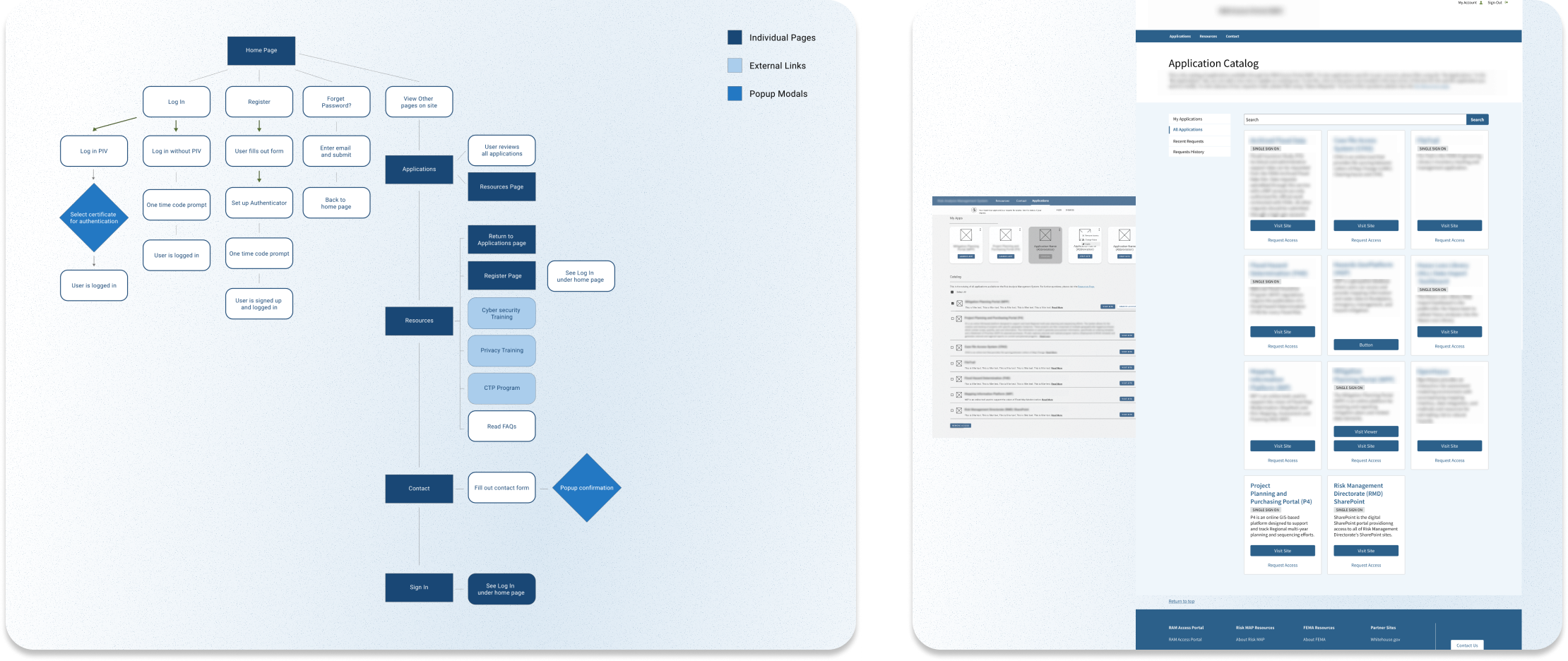
Flow Audit & Simplification
Documented the existing journey, identified friction points, and reduced redundant steps. Internal and external pathways were clarified to reduce cognitive load.
Information Architecture
Restructured navigation and application catalog to improve discoverability and reduce ambiguity.
Design System Integration
Aligned redesigned flows with the agency design system to ensure consistency, accessibility compliance, and scalability.
Accessibility & Compliance
Evaluated design decisions against regulatory requirements, ensuring responsive behavior across devices while maintaining usability standards.
Outcome
The platform transitioned from a fragmented legacy interface to a structured, scalable experience.
- Simplified request journeys reduced friction
- Clarified navigation improved application discoverability
- Standardized components increased cross-platform consistency
- Accessibility compliance was strengthened
- The system became positioned for long-term scalability
